Showing posts with label theory. Show all posts

01 September 2010

I was born...

I have a new wrinkle. I found it just now looking in the mirror back at me.

It's just above the inside corner of my left eyebrow. I didn't have this wrinkle as a 28-year-old. It is my 29-year-old self peaking through the younger facade.

I thought that a few musings on this day of days would be somewhat appropriate. Especially since I just returned home from a graduate seminar on feminist theories of natality, Hannah Arendt's reworking of the persistent emphasis on death by Western philosophy. Natality is the primal condition of being born, of the coming-into the political by a subject. It is hope and change. We all experience natality but only in its absence. I say, "I was born on September 1, 1981 in Seattle, Washington," but I wasn't really there. We weren't there as a fledged speaking subject capable of expressing our immediate potentiality.

I was born... to two loving parents who had all the hope in the world for me. Although Arendt's concept of natality is not limited to physical birth, the capacity for each human being to be born presents them with the potential for political agency. To be part of a public, and act in such a way to enables the potentiality in others, can liberate the staid ideology of the old guard focused on the second absent event, death. At death, we return to an unspeakable state. Death can be witnessed but not experienced. To what extent does birth imply a more public event? As the mother becomes mother and child, the splitting of one into two is not reversed with death. In death, two becomes one in the return of our physical body to the earth, but this can only be seen as a political, public act if we ascribe agency to the earth. By grounding this theory in the inorganic, or inanimate subject, vital matter assumes a subjective role over the dead.

Back to the wrinkle. The intersection of birth and death is life, an event that can be experienced. We can speak about life. We can act with intention, thereby fulfilling the promise of natality given at birth.


25 July 2010

OMG

Snooki in the NYTimes

Why is this news? Why does it merit an article in the Sunday Magazine? As a representative of the cultural zeitgeist, what does this say about us? We are just as whorish as Snooki in her cleavage-bearing dresses and classless demeanor in our fascination with the vomit-inducing vomiting and sex-capading on The Jersey Shore. Are we more pluralistic in our embrace of this cultural icon? Is Snooki the great class equalizer?

I doubt it. It's like watching a train wreck or car accident. We know we should look away and better ourselves with something more sustaining, but we can't.

I've never even seen the show.

24 July 2010

Time Being

I reconsidered the phrase, "for the time being," the other day. Instead of assuming the regular definition of the cliche, I thought, what is a time being?

A time being, a zeit-sein, is not a being-in-time. It is not Heidegger's Dasein who realizes his ultimate goal in his historicization, his temporality. A time-being is temporality embodied. In embodying time, the time-being identifies with birth and death. The time-being realizes his Being in birth, but most haunts the Dasein in death.


God's separation of light from dark, of birth from death, conceived the time-being. Thus, it is the progeny of a movement towards categorization.

This lack of stasis prompts the invocation of the time-being. At this moment, for the time being, the world acts according to our desires. However, the fragility of time negates any confidence in the time-being. It is always fleeing, always threatening, always moving us towards death.

But also life.

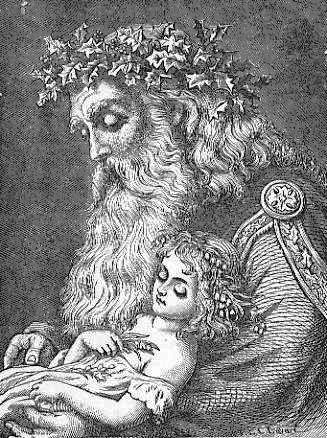
Father Time is figured as both a New Year's baby and the gaunt old man with Death's sickle. Death gives way for birth as we perpetually move from light to dark and back again.

File:Father time 7765.jpg

We all have a time-being. Perhaps it is like the daemon in ancient Greek religion. A benevolent spirit that accompanies us in our mortal life and induces eudaemonia (happiness) instead of thanatos (death). It's always over our shoulder, over the next hill, around the next bend, already here and still to come.